
Portal Gear Lifts vs Lift Kits Compared
Posted by Drew Cummings on Oct 12th 2026
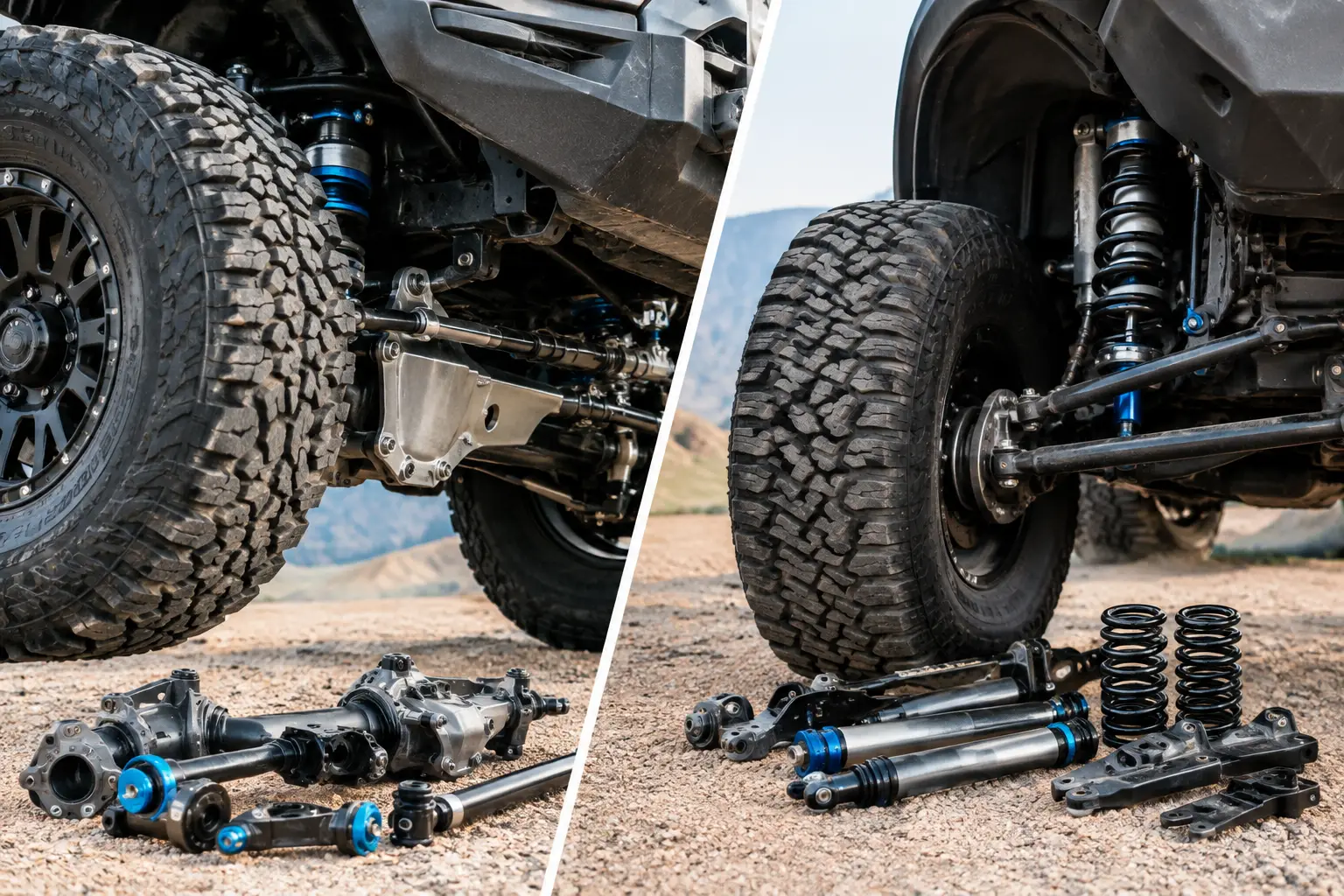
A shallow creek crossing or a rutted lease road can expose the weak point of a stock UTV fast: the differential housings sitting low between the tires. That is why the portal gear lifts vs lift kits decision matters more than simply choosing how tall you want your machine to look. Both upgrades can make room for larger tires and improve your ability to cover rough ground, but they change the vehicle in very different ways.
For most riders, the right answer comes down to terrain, tire size, workload, and how much added maintenance they are willing to take on. A lift kit is often the practical route for trail riding, ranch work, and moderate tire upgrades. Portal gear lifts are purpose-built for riders who need serious ground clearance, lower effective gearing, and mud-ready capability.
How a Standard UTV Lift Kit Works
A lift kit raises the chassis and suspension relative to the wheels. Depending on the design, it may use shock spacers, spring spacers, replacement A-arms, or bracket systems that reposition suspension mounting points. The goal is usually to create clearance for taller tires while improving approach, departure, and breakover angles.
The key detail is where the clearance comes from. A conventional lift raises the body, skid plate, and other chassis components, but it does not directly raise the differentials above the ground. The differential height only increases when you install a taller tire. If your stock tires are 28 inches and you move to 32s, the axle centerline rises about 2 inches. That is the clearance gain beneath the differential.
This still makes a lift kit a smart upgrade for plenty of UTV owners. It can improve stance, fit the tires needed for rocks or loose terrain, and give the machine a more capable footprint without adding gearboxes at every hub. Quality kits built for your exact Polaris, Can-Am, Yamaha, Kawasaki, or Honda platform are especially important because suspension geometry, steering range, brake-line length, and axle angles all need to remain in a safe operating range.
What lift kits do well
A properly matched lift kit is usually lighter, less expensive, and easier to maintain than a portal system. It is a good fit for riders running moderate tire sizes who want more clearance for trail obstacles, snow, hunting roads, or property work. It can also be the better choice for machines that spend time at higher trail speeds, where added unsprung weight and steering effort become more noticeable.
Not all lift kits perform the same. A basic spacer lift may work for mild use, but a more complete bracket or long-travel system can do a better job preserving suspension movement and reducing harsh axle angles. The best choice depends on the amount of lift and the vehicle platform, not just the advertised lift height.
Portal Gear Lifts vs Lift Kits: The Mechanical Difference
Portal gear lifts mount a gear reduction box at each wheel hub. The axle feeds into the portal box, and the wheel hub sits lower than the axle centerline. That offset is what produces their major advantage: true ground clearance under the differentials.
For example, a portal system with a 4-inch lift raises the differential roughly 4 inches before tire size enters the equation. Add larger tires, and the UTV gains even more clearance. That is a major advantage in deep mud, water crossings, stump fields, rock ledges, and heavily rutted trails where diff housings constantly drag.
Most portals also provide gear reduction. Common reduction ratios such as 15% or 30% lower the final drive ratio, which helps bring back low-end torque lost when larger tires are installed. This can reduce belt strain, improve crawl control, and make it easier to turn big mud tires through thick terrain. For a heavy, tire-loaded machine, that gearing benefit may be as valuable as the added lift.
The trade-off is that portals add substantial weight at the wheels. This is unsprung weight, meaning the suspension has more mass to control over bumps. Steering can feel heavier, acceleration may change depending on the reduction ratio, and high-speed handling can become less precise. Portal boxes also require periodic oil checks and service. They are not a bolt-on-and-forget-it accessory.
Where portals earn their cost
Portals make sense when clearance is the limiting factor, not just tire fitment. If your riding regularly involves deep mud holes, creek beds, swamp trails, oversized ruts, or slow technical crawling, a portal system can keep the driveline out of trouble in ways a conventional lift cannot.
They are also useful for work machines that carry loads through rough, wet ground. A UTV used around a farm, hunting property, or remote camp may benefit from the lower gearing and extra differential clearance, especially when it runs a loaded bed, cab enclosure, winch, and larger tires.
For ordinary woods trails and hard-packed roads, however, the portal advantage may be more than you need. Spending that budget on a quality lift, tires, skid plates, clutch tuning, and recovery equipment can produce a more balanced machine for mixed-use riding.
Tire Size Changes the Equation
Tire size should be planned with either upgrade. Taller, heavier tires improve obstacle clearance and traction, but they also add rotating mass. That can slow acceleration, increase steering effort, raise clutch temperatures, and put more load on axles, wheel bearings, and brakes.
With a standard lift kit, tire size does much of the work of raising differential clearance. That makes correct clutch setup and drivetrain condition especially important when moving well beyond stock diameter. With portals, the gear reduction can help offset the load of big tires, but it does not eliminate the need to consider axle strength, wheel offset, and overall vehicle width.
Before choosing a tire, verify actual mounted diameter rather than relying only on the size printed on the sidewall. Tire brands and tread designs vary. Also check whether the lift or portal setup requires specific wheel backspacing, lug patterns, or wheel sizes. Fitment is more than whether the tire physically clears the fender at a standstill. It must clear through full steering and suspension travel.
Steering, Width, and Everyday Usability
A tall UTV that feels planted on a mud trail can become less convenient on a narrow mountain path, in an enclosed trailer, or beside a fence line. Portal systems commonly widen the stance, and some lift-and-wheel combinations do the same. That added width can improve stability, but it can also create clearance problems on tight trails and affect local trail-width rules.
Steering geometry deserves equal attention. Lifting a UTV changes the relationship between tie rods, A-arms, and the steering rack. Low-quality or poorly matched kits can contribute to bump steer, reduced turning radius, or accelerated wear. Portals introduce their own steering considerations because the added mass and offset affect how the vehicle responds at the wheel.
If the machine is used for plowing, chores, hunting, and family trail rides as much as mud riding, keep the build practical. A moderate lift and appropriately sized all-terrain tire often retains better everyday manners than an extreme-height setup.
Cost and Maintenance Expectations
Lift kits generally cost less up front, particularly simple spacer designs. The total build cost rises when you add larger tires, wheels, clutch components, upgraded axles, or suspension parts, but it remains a more accessible path for many riders.
Portal gear lifts are a larger investment. Beyond the portal boxes themselves, you may need compatible wheels, upgraded steering components, brake-related parts, or other model-specific hardware. Plan for routine portal gear oil service and inspect the system after hard rides for leaks, loose hardware, and impact damage.
Neither option should be selected as a universal upgrade. Choose products designed specifically for your year, make, and model, then account for the accessories already on the machine. A cab enclosure, bumper, winch, cargo rack, and loaded bed all affect the suspension and drivetrain demands of the final build.
Choose the Upgrade Around Your Terrain
Choose a lift kit when you want a cost-conscious way to fit moderately larger tires, improve chassis clearance, and keep the UTV suited to mixed trails and regular work. Choose portals when deep terrain demands maximum differential clearance, you want reduction gearing for large tires, and you accept the added weight, width, cost, and maintenance.
Before ordering, measure your trailer, confirm your typical trail restrictions, and be honest about the terrain that stops your UTV most often. The right setup is the one that solves that problem without creating three more on the ride home.